Federal Grants 101: How It Works, in Plain English
Granteon ·
A federal grant is money the government gives your organization to do a specific job for the public. You don't pay it back. In exchange, you do the work you described, spend the money the way you said you would, and prove both with reports. Grants.gov calls a grant a way the government funds your ideas and projects to provide public services and stimulate the economy. We think of it as a contract with a very patient, very thorough customer.
If your organization has never applied, the official guides can read like they were written for people who already know the process. So here it is in order, with every term explained the first time it shows up.
Sign Up Before You Need To
You can't apply on Grants.gov the day you find a grant you like. Your organization has to be registered first, and registration takes longer than anyone expects. If you only act on one section of this post, make it this one.
Start with SAM.gov, the System for Award Management. It's the federal government's address book of every organization it might pay. Registering is free. When you finish, you get a Unique Entity ID, or UEI: a twelve-character ID that tells every federal agency which organization you are. Grants.gov says to allow up to ten business days for a SAM.gov registration to go active, and if your information doesn't match the records it gets checked against, it can take weeks or months. You also renew it every year. A lapsed registration can stop an application cold.
Once SAM.gov is active, the person listed as your Electronic Business Point of Contact (EBiz POC) creates a Grants.gov account with the same email they used in SAM.gov, then adds your organization using its UEI. The EBiz POC is the account owner. They hand out roles to everyone else, and the one that matters most is the Authorized Organization Representative, or AOR: the person allowed to work on applications for your organization.
So the order is SAM.gov, then your UEI, then a Grants.gov account, then roles. Do it now, months before any deadline, so paperwork isn't the reason a good match gets away.
Step 1: Before the Award
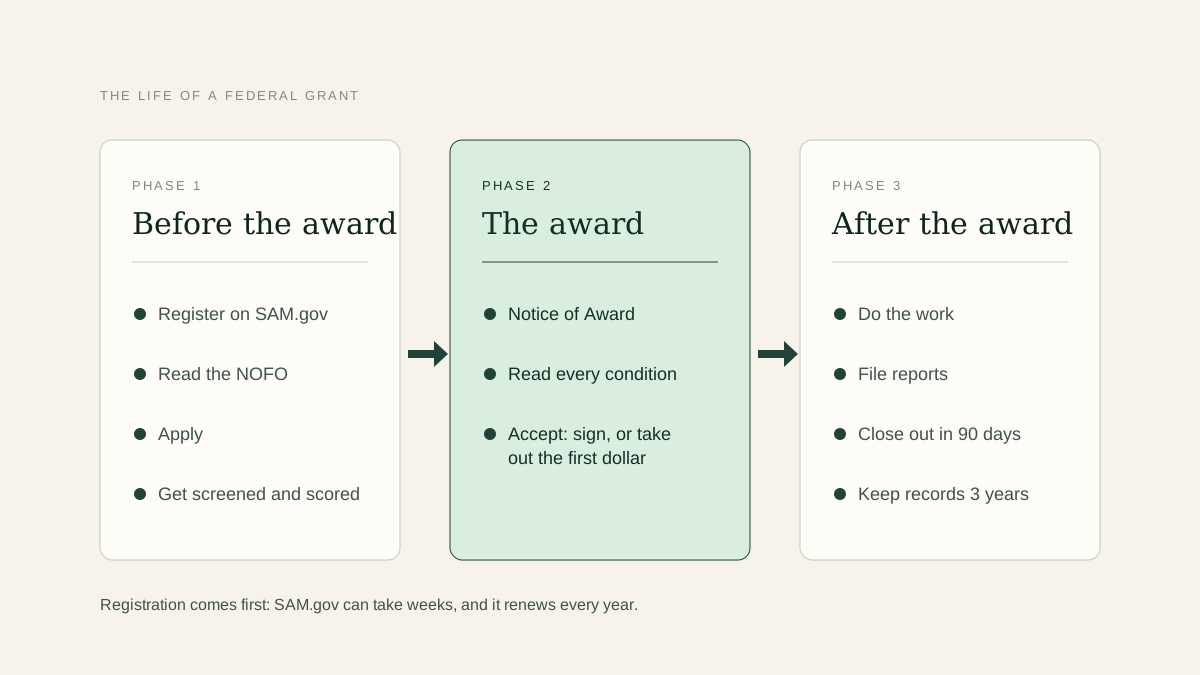
Grants.gov splits the life of a grant into three phases. The first covers everything that happens before anyone says yes.
It starts when an agency publishes a funding opportunity, usually called a Notice of Funding Opportunity, or NOFO. A NOFO is the job posting for the money. It says what the agency wants to pay for, who's allowed to apply, how much is available, what the application has to include, and how it will be scored. Read the eligibility section first. If your type of organization isn't on the list, good writing won't change that.
Your application then goes through four checks. First, initial screening: someone confirms you included every required piece, and a missing form can end the review right there. Second, programmatic review: independent experts, usually a panel of at least three people, score your application with the agency's own scoring system. This is where your plan gets judged. Third, financial review: the agency goes through your budget line by line to see whether the costs make sense for the work. Fourth, the decision and the announcement.
Step 2: The Award
If you're selected, you get a Notice of Award, or NOA. It's the official, legally binding document, which makes it the contract. It spells out how much you get, for how long, and the terms and conditions you have to follow.
You accept the award either by signing the agreement or by drawing down funds, which means taking out the first dollar. That second one catches people off guard. Spending the money counts as saying yes to every condition attached to it, so read the whole NOA before you touch it.
Step 3: After the Award
The third phase is doing the work and showing that you did it. It runs for the whole grant and a little past the end.
The agency assigns two people to your grant. A program officer follows the work. A grants management officer follows the money. Grants.gov recommends staying in touch with both, and we'd add: call them when something changes, before it turns into a problem.
You'll file two kinds of reports. Financial reports show how the money was spent. Performance reports show what the work achieved against the goals in your agreement. How often you file depends on the grant, so check your terms.
If your organization spends $1,000,000 or more in federal awards in one fiscal year, you need a single audit: one independent audit that covers all of your federal money together. Grants.gov's own page still lists the old $750,000 figure, but the federal rules raised the threshold to $1,000,000 for fiscal years starting on or after October 1, 2024.
When the grant ends, closeout begins. You have 90 days after the end date to submit every final report. After that, keep your grant records for at least three years from the date you submitted your final expenditure report.
Words You'll See
NOFO (Notice of Funding Opportunity): the announcement that a grant exists, with the rules for applying. Some agencies call it an FOA, a funding opportunity announcement.
SAM.gov: the government's list of organizations it can pay. Free, renewed every year.
UEI (Unique Entity ID): your organization's ID number across the federal government. SAM.gov gives it to you.
EBiz POC (Electronic Business Point of Contact): the person who controls your organization's Grants.gov account and gives other people access.
AOR (Authorized Organization Representative): someone allowed to work on and submit applications for your organization.
NOA (Notice of Award): the official letter saying you won. It's legally binding.
Drawdown: taking money out of your grant, usually as you spend it. Your first drawdown also counts as accepting the award.
Closeout: the wrap-up at the end of a grant, when final reports are due within 90 days.
Single audit: one independent audit of all your federal funding, required once you spend $1,000,000 or more in a fiscal year.
Where to Start This Week
Check whether your organization already has an active SAM.gov registration and a UEI. If it doesn't, start today. It's the slowest step and the one most likely to block you. Then read one NOFO from start to finish, even one you won't apply for, just to see how they're put together. When the Find grants page shows you a Grants.gov listing that fits, you'll already be cleared to apply.