Match grants you'll win, write them in minutes
$5.4 billion in open grants, get your piece for your org.
See if we know your organization.
If eligible, Granteon fills in your tax info and finances for you.
Not listed? You can still sign up and enter your details.
Our own grant database. Our own matching.
Matched by meaning, not keywords.
Granteon keeps its own database of open grants from across the US: federal ones, plus open calls from a growing list of state, local, community and private funders, and ranks each grant by how closely it fits your work.
Then slide from Exact match to Wild card to choose how far to reach.
A lot of the Tuesday regulars are isolated seniors. Halcyon funds healthy aging, and the research on loneliness and mortality is established enough to cite outright. The weekly meal becomes a social health intervention.
Wellspring is a health funder, not a hunger one. Lead with the research linking food access to diabetes and hypertension outcomes, then pitch the pantry as preventive care: a 'food as medicine' site.
Polyglot funds cultural exchange, not aid. Frame the newcomer dinners and language tables as two-way bridge-building rather than charity. Lead with the exchange.
Example grants. Yours come from the live database.
Create a proposal in minutes, more proposals per year.
More applications, less time per proposal.
Sources
Everything a nonprofit, research team, or company needs to win a grant.
Your concerns, covered.
Never miss a deadline
Deadlines
Every grant you're watching and every application you've started lands on one calendar, ringed on the day it's due. Open a day to see exactly what's due and jump straight to the work.
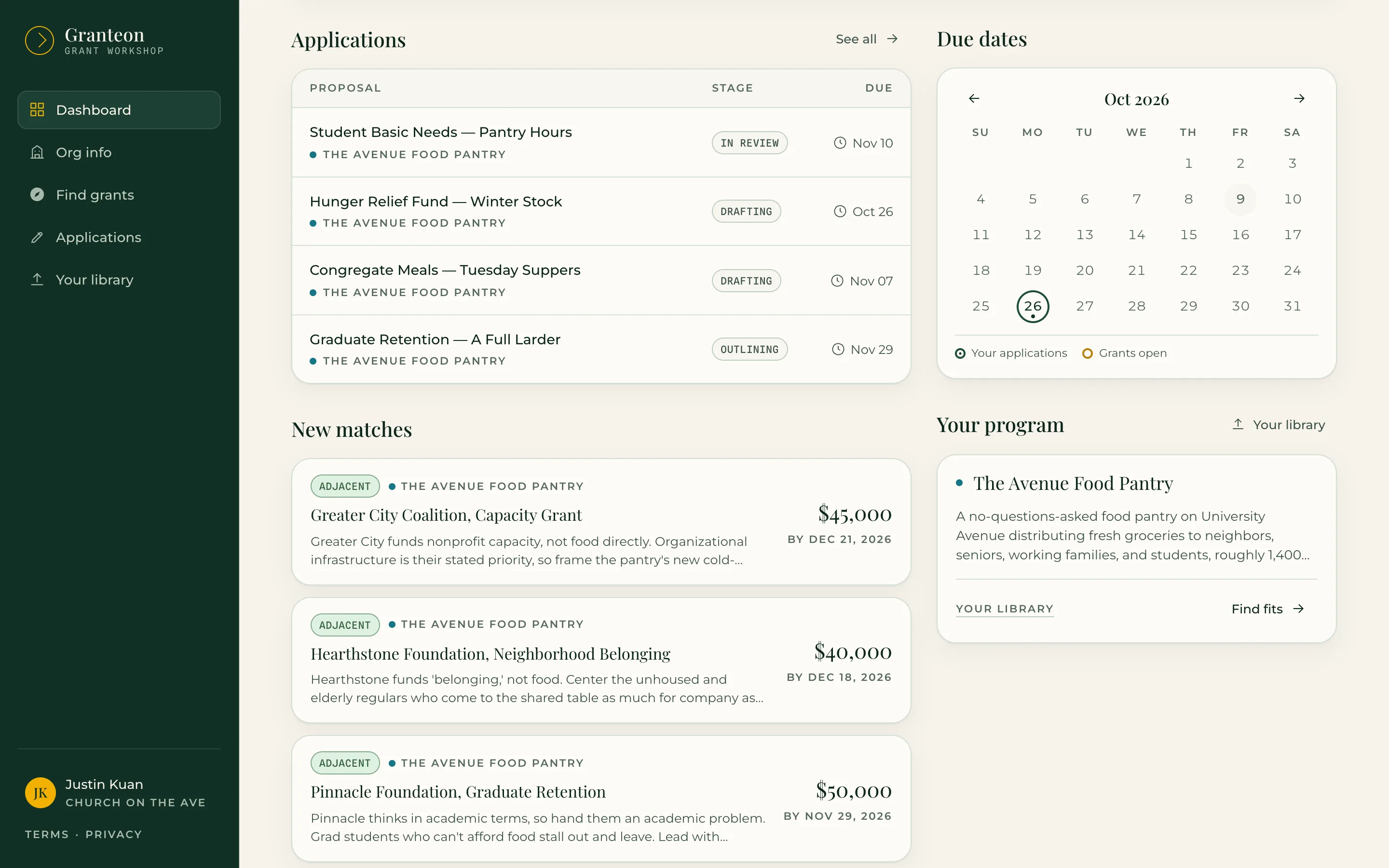
Start from a draft
Drafting
Tell Granteon about your organization once: mission, past proposals, budgets. Every new application opens with a first draft written from that background, so your hours go into refining, and your writers keep the pen.
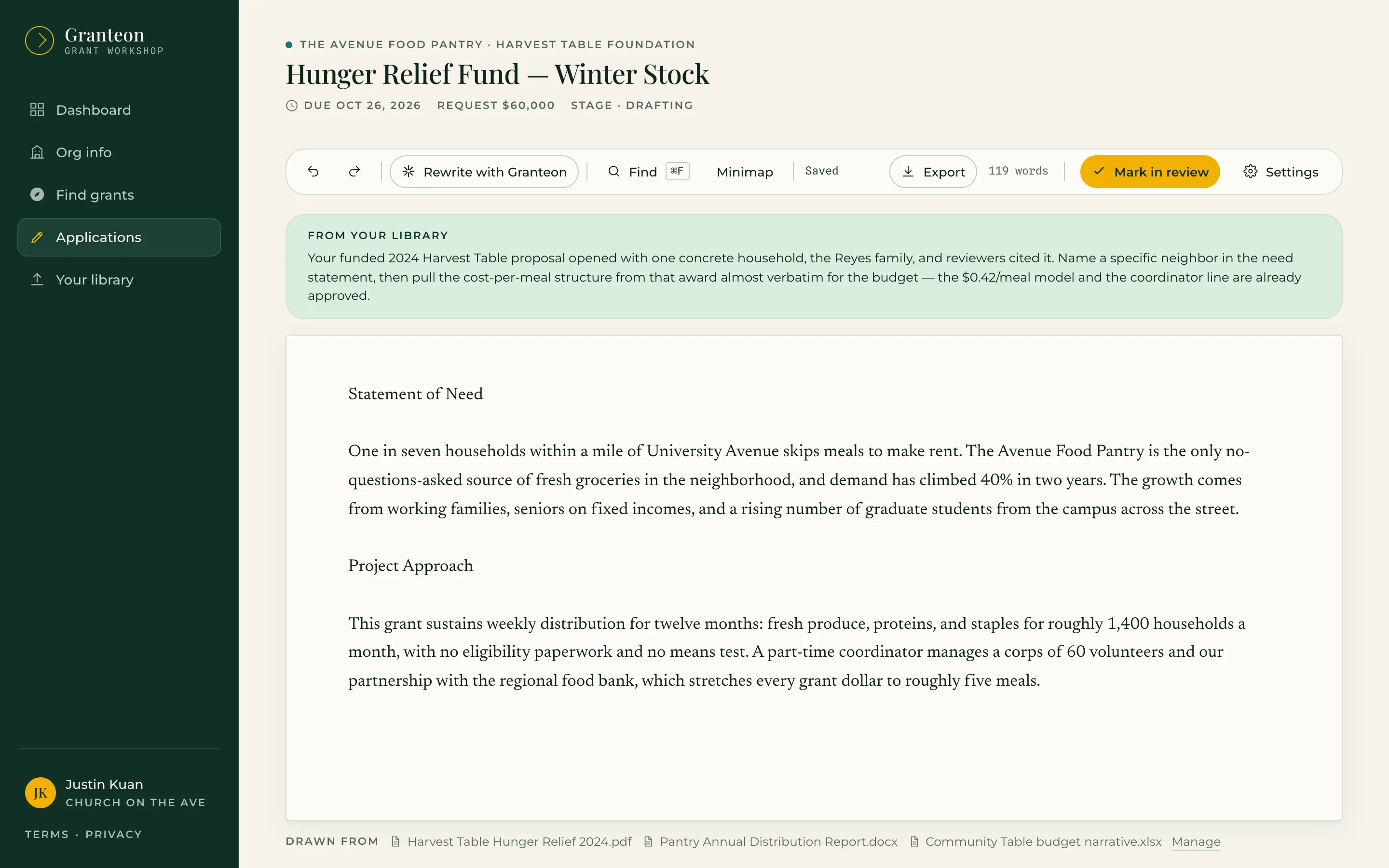
Everything together
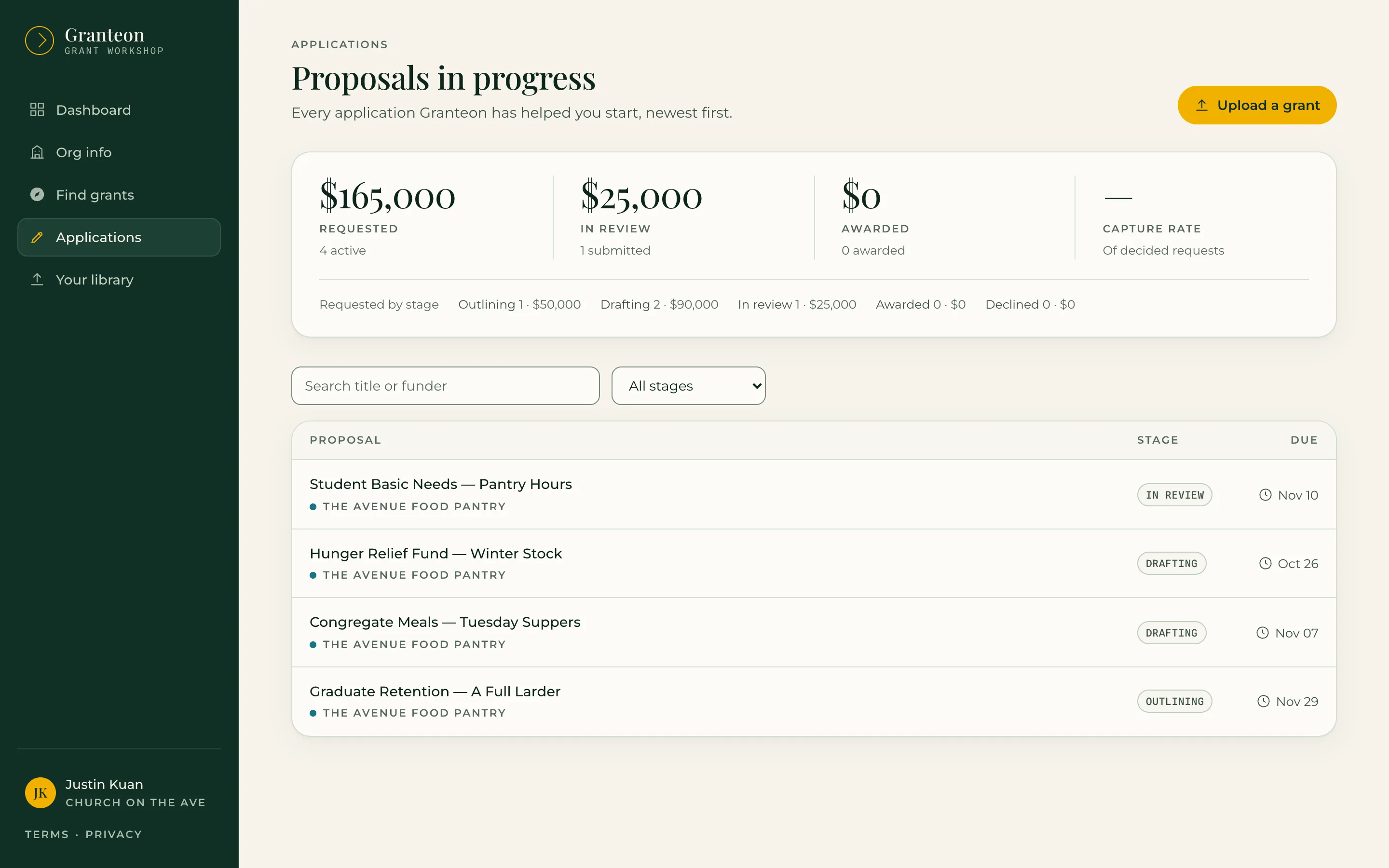
One place
Drafts autosave as you type, and every application stays on one list with its funder, amount and deadline. When it's time to submit, export to Word, PDF or plain text.
You own your data
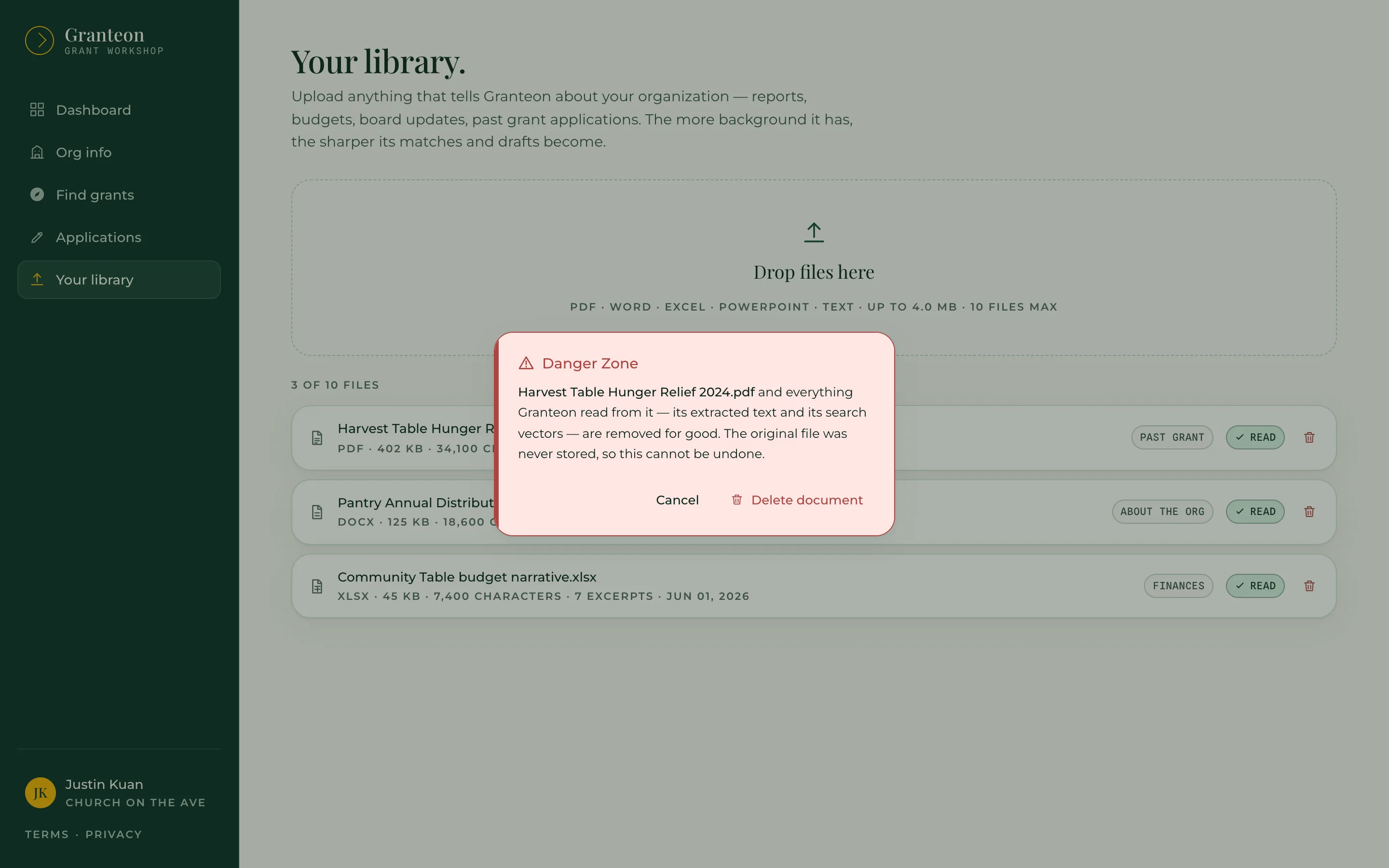
Your data
Nothing you upload trains our models, and we never keep your original files, only the text we read from them. Remove a document or an application for good with one click, or ask us and we'll delete everything Granteon holds for you.
Not just ChatGPT.
Humanistic AI, tuned to write for your organization.
Humanistic AI is Granteon's writing system. Our AI engineers built and tuned it for one job: grant proposals that sound like your organization wrote them. It runs on commercial AI models, and what we built is the work around them. It drafts from your past proposals, reports and budgets, matches the voice in them, and is told to leave a fact out rather than invent one.
We never train AI on your data. Not ever.
Nothing you upload or write trains any model, ours or those of the AI vendors we send it to.
| Question | Granteon | ChatGPT on its own |
|---|---|---|
| Grant database | Open federal grants nonprofits can apply for from Grants.gov, plus open calls from a growing list of state, local, community and private funders, pulled regularly. | No grant database of its own; it can search the web on every plan. |
| Matches grants to your organization | Yes: by meaning, against your organization's description, registration and past grants, with a reason for each match. | No grant matching; you ask it to search. |
| Checks your eligibility | Yes: checks each grant's deciding eligibility rules against your organization, flags any you fail and ranks them last. | No built-in eligibility check. |
| Drafts proposals with AI | Yes: drafts and rewrites from your own uploaded reports, budgets and past proposals. | Yes, general purpose: it can draft from files you add to a project (5 on Free, 25 on Plus). |
| How it sounds | Matches the voice in your documents and avoids common AI tells. | Writes well, in the style you ask for. |
| Your data | Never used to train AI, ours or our vendors'. | Free, Plus and Pro chats may train OpenAI's models unless you turn that off; Business and Enterprise don't by default. |
Sources
Skeptical of AI? Good.
Here's what we'd ask too.
Isn't Granteon just ChatGPT with a nicer screen?
No, though it's a fair question. Granteon runs on commercial AI models, not one we trained ourselves, and ChatGPT writes well. What ChatGPT doesn't have is a grant database, grant matching or an eligibility check. Granteon has all three, and it drafts from your own documents with Humanistic AI, the writing system our AI engineers tuned for grants.
Will a Granteon draft sound like a robot wrote it?
It's built not to. Humanistic AI, Granteon's writing system, matches the voice in the past proposals and reports you upload and avoids habits that give machine writing away, like tacked-on phrases and words such as "pivotal". With nothing uploaded it has little of your voice to go on, and no tool gets every sentence right, so read each draft and change what doesn't sound like you.
Does Granteon make up facts or statistics?
Granteon is told never to. It takes figures, names and partners from your documents and leaves out a fact it doesn't have rather than guess. AI models can still get things wrong, so every draft reminds you to review each line, and Suggest edits can flag a figure only you can supply.
Do funders accept AI-assisted grant proposals?
Most haven't decided, and Granteon doesn't track each funder's rules, so check them first and make any disclosure they ask for. In Candid's 2024 survey of foundations, 67% were still undecided about accepting AI-generated applications and 23% said they would not accept them. In a 2026 survey of 176 grant professionals by Instrumentl, which sells grant software, 72% said they worry funders will penalize AI-assisted proposals. NIH won't consider research applications substantially developed by AI, so Granteon is a poor fit there.
Will an AI detector flag a Granteon draft?
It might, and Granteon isn't a way around one. We don't promise a draft will pass a detector, and we won't help you hide AI use from a funder that bars it or asks you to disclose it. In Candid's 2025 survey, 97% of foundations said they weren't using generative AI to screen applicants or decide whom to fund, but rules vary, so follow each funder's.
Does Granteon train AI on my data?
No, never. Nothing you upload or write in Granteon trains any AI model, ours or those of the AI vendors we send it to. Those vendors process your text to produce your draft, and one may keep requests for a limited time to check for abuse, but not to improve its products. Granteon isn't built for health records, so keep those out.
Will Granteon replace our grant writer or our judgment?
No. Granteon finds grants, checks eligibility and writes a first draft, and that's where it stops. It never contacts a funder or submits anything. Funder relationships, the decision to apply and the final word stay with your team, and a draft is a starting point for them to edit and own.
Sources
- Candid, Where do foundations stand on AI-generated grant proposals? (2024)
- Candid, Will AI soon be reviewing your grant applications? (2025)
- Instrumentl, Grant Professionals Are Drawing the Human-AI Line in the Wrong Places (2026)
- NIH, NOT-OD-25-132: Supporting Fairness and Originality in NIH Research Applications (2025)
Straight answers for the person who buys the tools.
How we guard your data.
Walled off by organization
Only the people your organization invites can see its data. Our server checks who is asking on every request, and the text we pull from your documents, with its search vectors, is stored where no browser can read it, yours included.
We keep the text, never the file
Uploads are read once and the original file is thrown away; only the text is kept. Delete a document and its text and search vectors go with it.
Encrypted, and stored in the US
Your data is encrypted in transit and at rest, and stored in the United States. Payments run through Stripe, so card numbers never touch our servers.
Questions people ask about Granteon.
Plain answers.
What is Granteon?
Granteon is AI grant writing software for nonprofits. It matches your organization to open grants from across the US (federal ones from Grants.gov, plus open calls from a growing list of state, local, community and private funders), checks each grant's eligibility rules against your organization, and drafts proposals from your own documents. Every account starts with a 14-day free trial, no card needed.
Who is Granteon for?
Granteon is built for nonprofits that apply for grants, from an executive director writing proposals alone to a development team of a few people. Matching covers federal grants open to nonprofits, plus open calls from a growing list of state, local, community and private funders. Anyone, research teams and companies included, can upload a funder's call and draft against it.
Where do Granteon's grants come from?
Granteon keeps its own database of open grants, pulled regularly: every posted Grants.gov listing nonprofits can apply for, plus the open calls a growing list of state, local, community and private funders post, each deadline and amount checked against the funder's own words. Closed calls are removed. Found a grant we don't list yet? Upload the funder's call and Granteon reads its requirements and checks your eligibility the same way.
How does Granteon match grants to my organization?
Granteon reads your organization's description, its registration details and the names of your past grant files, and finds the open grants closest in meaning, not by keyword. It sets aside grants open only in another state and any closing within 10 days, and puts ones your type of organization can't apply for last. An AI model then ranks the closest, checks each grant's deciding eligibility rules against your organization, flags any you fail and ranks them last, and says why each grant fits. You see up to 25 matches (10 on Trailblazer, 5 on Pathfinder, the top 3 during the trial).
How much does Granteon cost?
Granteon starts with a 14-day free trial with no card: your top 3 grant matches and 10 drafts or rewrites. Pathfinder is $99 a month for up to 5 matches and 20 drafts or rewrites a month. Trailblazer is $559 a month for up to 10 matches and 40 drafts or rewrites a month. Mountaineer is $899 a month for up to 25 matches and 120 drafts or rewrites a month. Change or cancel any time.
What does Granteon do with my documents?
Granteon reads each upload once, keeps only the text and its search vectors, and throws the original file away. Nothing you upload trains any AI model, ours or our AI vendors', and no one outside your organization's team can see its data. Deleting a document removes its text and vectors. Data is encrypted in transit and at rest and stored in the United States. The library holds up to 10 documents of up to 4.0 MB each.
Can I export proposals from Granteon?
Yes. Drafts autosave as you type and export to Word, PDF or plain text, or copy one answer at a time into the funder's form. Granteon never submits anything for you: you submit on Grants.gov or the funder's own portal.
Notes on winning grants.
From the blog.
Short, practical reads on finding funders, reading guidelines, and writing proposals that get funded.

Granteon ·
How to Read a NOFO: 8 Required Sections, 3 to Read First
Every federal NOFO must use the same eight sections. Read Eligibility, Program Description, and Review first: they hold the dealbreakers and the cost limits.
Granteon ·
De Minimis Indirect Cost Rate: 15%, Except Where It Is 10%
The de minimis rate is up to 15% of modified total direct costs, not your whole budget, and NIH still pays 10%. The math, the exclusions, and the rules.
Granteon ·
Government Shutdown: What Happens to Your Federal Grant
Federal funding runs out December 11, 2026. What a shutdown stalls for grantees, what keeps paying, and why a bridge loan's interest stays off the grant.